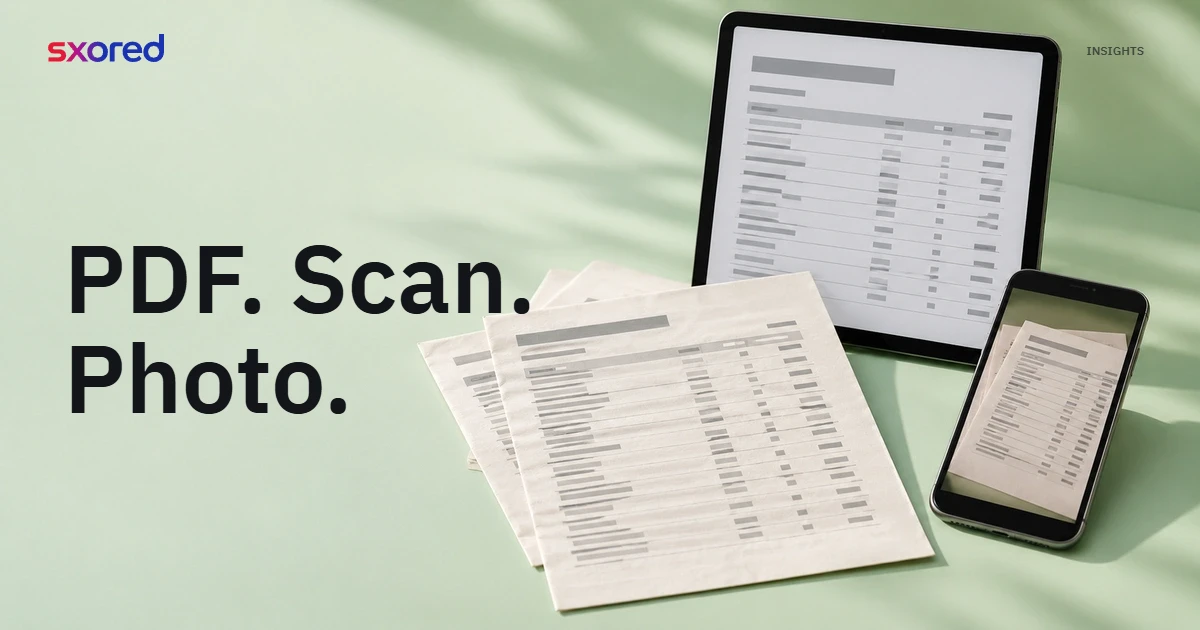
A borrower sends twelve months of bank statements as PDFs, a few of them photographed on a phone. A few minutes later the processing tool returns a neat transaction table, and it would be easy to start totalling credits straight away. Before you do, it helps to know what shaped that table. A scanned page, a missing page or an unfamiliar layout affects how dates, amounts and debit/credit directions are read, which is why good tooling surfaces uncertain readings for review instead of hiding them.
The time saved is greatest when the analyst can confirm the data quickly. What should a credit team check before relying on bank-statement data produced by document processing?
What document processing actually does
Intelligent document processing (IDP) converts information in documents into data that a team can search, organise and review. Optical character recognition (OCR) is one part of that work: reading text from images. Extracting a transaction table also means deciding which values belong to the same transaction.
A digital statement can contain machine-readable text, scanned pages or both, so a clean-looking table is most useful when each value can be checked against the page it came from. For credit teams, the useful output is a reviewable record of account movements, which the analyst then interprets.
Is the source document complete and readable?
Extraction can only be as good as its input, so the first check is the document itself. Before relying on extracted information:
- Confirm the account holder, account identifier, currency and statement period.
- Check page order and whether the beginning or end of the period is missing.
- Prefer original bank-issued files when they are available.
- Keep a readable copy of the source for later review.
- Record limitations such as cropped images or incomplete periods.
Image quality affects recognition. A blurred phone photo, a skewed scan or a table with merged columns is harder to read than a statement downloaded from internet banking, so give those pages a closer look.
How much should a confidence indicator be trusted?
A confidence indicator on extracted values helps decide what to review first: readings marked uncertain get a look before the rest. It describes how a value was read, so a high indicator is not proof that the statement is authentic; authenticity is checked against the document itself.
Review goes fastest when each extracted value links back to its source page and a correction keeps the original reading alongside it. The analyst can then confirm a figure in seconds instead of searching the PDF.
Balance reconciliation adds a second safety net. When opening balance plus credits minus debits does not equal the closing balance, the gap points to something worth tracing, often in the source material itself.
Example: the extracted table for PT Arunika Niaga, a fictitious building-materials trader, shows an opening balance of IDR 312.400.000, credits of IDR 1.180.000.000, debits of IDR 1.095.600.000 and a closing balance of IDR 412.800.000. Opening plus credits minus debits gives IDR 396.800.000, a gap of IDR 16.000.000. The reconciliation check flags the gap before anyone totals the credits. Tracing it, the analyst sees that the submitted PDF skips page 7, whose movements net to IDR 16.000.000. The borrower is asked for the complete statement, and the credit total is used only once the period is whole.
Extraction is not credit judgment
Even a perfectly read statement only tells you what moved through the account. An accurately read transfer could be a loan disbursement, an internal transfer or a refund rather than a customer receipt; checking for funds that leave and return is part of that analysis.
Before using the data, review material transactions against their descriptions and supporting records, and check whether relevant accounts or periods are missing. An absent value is not a confirmed zero.
An unreadable statement leads to a clear follow-up, such as requesting a better source, rather than a credit conclusion without support.
Checklist before using extracted statement data
- The source covers the right account, currency and full period, with no missing pages.
- Every extracted value can be traced to the source and corrected without losing it.
- Opening balance, movements and closing balance reconcile, or the gap is explained.
- Confidence is used to decide what to review first.
Sxored scores the extraction quality of each bank statement, shows a warning that lists the checks that failed, highlights balances that do not reconcile, and lets the analyst correct extracted transactions and their categories. For the borrower’s reported obligations, continue with how to read a SLIK OJK iDeb report.